


History of Black Eyed Peas


1989 - 1995
Early Beginnings
In 1989, apl.de.ap immigrated to the United States from the Philippines through a sponsorship program aimed at giving him greater opportunities. He moved to East Los Angeles, where he stayed in the apartment of will.i.am’s uncle (will.i.am was then known as Will 1X). This chance connection led to a friendship between Apl and Will. The two bonded over their love of music and dance, frequently attending rap-dance events together. Before long, they formed a breakdance crew called Tribal Nation, performing at local venues such as Ballystix in Los Angeles.
Nurturing Musical Aspirations
Determined to support her son’s creative dreams, Apl’s mother enrolled him at Palisades Charter High School, hoping to foster his musical growth. Around the same time, Will began rapping, MCing, and DJing at nightclubs. Recognizing Apl’s potential, he encouraged him to rap despite his limited English. Their combined efforts soon attracted attention—most notably from rapper Conejo, who introduced them to producer DJ Motiv8. Motiv8 offered to mentor Will in music production, and the pair began creating tracks from his apartment.
Forming A.T.B.A.N. Klann
With their growing experience and network, Will, Apl, DJ Motiv8, and Mooky Mook decided to form a rap group, A.T.B.A.N. Klann—short for A Tribe Beyond a Nation. In 1992, the group signed with Eazy-E’s Ruthless Records. Alongside their label work, they became part of Grass Roots, a vibrant Los Angeles arts collective that united dancers and musicians such as Huck Finn; Mr. Shaah, who performed in Pablo with rapper Taboo; Dandillion, the first female vocalist to collaborate with Will and Apl; and Dante Santiago.
Early Releases and Setbacks
A.T.B.A.N. Klann debuted as featured artists on Eazy-E’s track “Merry Muthafuckin’ Xmas.” In 1994, they released their first single, “Puddles of H2O.” Their debut album, coincidentally titled Grass Roots, was slated for release in 1995 but was ultimately shelved after the group was dropped from Ruthless Records following Eazy-E’s death.
Moving Forward
By 1995, the group had disbanded. Mooky Mook went on to form a new group, Burning Star, leaving Will and Apl to forge their own path in music production—a journey that would eventually lead to the birth of what became the Black Eyed Peas.
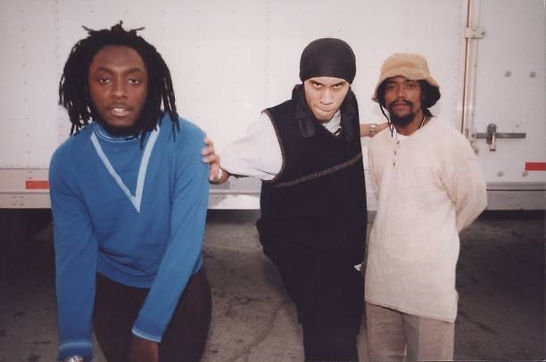
1995-1998
The Birth of the Black Eyed Peas
Following the disbandment of A.T.B.A.N. Klann, will.i.am, apl.de.ap, and Dante Santiago formed Black Eyed Peas. The group’s name—originally the production moniker used by DJ Motiv8 and will.i.am—symbolized “music for the soul,” inspired by the food black-eyed peas, often called “food for the soul.”
Early Performances and Lineup Changes
The Black Eyed Peas began performing at college campuses and opening for established artists while working on their debut album. Incorporating live instrumentation, they added drummer Terrence Yoshiaki and bassist Mike Fratantuno to the lineup. During the early recording stages, Dante Santiago left to pursue a solo career. Shortly after, Taboo—formerly of the group Pablo with Mr. Shaah—joined the group at DJ Motiv8’s encouragement, shifting his focus from breakdancing to rapping.
Collaborations with Female Vocalists
Remaining active in the Los Angeles underground scene, the group frequented clubs for rap battles and breakdancing competitions. At one such venue, they met singer and actress Ingrid Dupree, whose soulful voice caught will.i.am’s attention. She recorded vocals for the track “Joints & Jam”—initially a demo—marking her as the first female vocalist to work with the Black Eyed Peas, although she never officially joined the group.
In late 1995, will.i.am met singer Kim Hill while seeking a female vocalist for the track “The Way U Make Me Feel.” Drawn to her distinctive style, he invited her to collaborate further. Hill soon began performing regularly with the group and contributing to more recordings.
Building Behind the Front
As they worked on their debut album, the group drew inspiration from unreleased material from their A.T.B.A.N. Klann project Grass Roots. They also expanded their live band by adding guitarist Kevin Feyen and keyboardist Brian Lapin, who played a key role in the album’s production and engineering.
In 1997, the Black Eyed Peas signed with Interscope Records, receiving the green light from the company's co-founder Jimmy Iovine to release their first album. Their debut single, “Fallin’ Up” (with B-side “Que Dices?”), dropped in December 1997, followed by the release of their album Behind the Front on June 30, 1998.
A Breakthrough Debut
Behind the Front features 16 tracks recorded over a four-year period while the group was still evolving. Although Kim Hill had become the lead female vocalist, she appeared on only three tracks—many of the others originated as demos from the Grass Roots sessions. The album showcased a variety of guest artists, including Macy Gray on “Love Won’t Wait” and Redfoo (of LMFAO), who had attended high school with will.i.am, on “Duet.” Though “Duet” shares its title with a song from Grass Roots, its sound was entirely reimagined for the Black Eyed Peas debut.

1999-2001
Touring and Transition
Following the release of Behind the Front, the Black Eyed Peas joined the Smokin’ Grooves Tour in 1998, sharing the stage with other prominent acts. They also expanded their presence on the college and festival circuit, building a reputation for high-energy, live-instrument performances. In 1999, after releasing “Karma” as the final single from their debut album, the group began recording their second studio project.
During this time, Brian Lapin left to pursue other ventures. Interscope Records approached Printz Board to join as the band’s new keyboardist. Printz agreed—on the condition that his former bandmate, guitarist George Pajon Jr., could join as well. This reshuffle led to the departure of Kevin Feyen, solidifying a fresh lineup for the group’s next chapter.
The Bridging the Gap Era
Initially slated for a September 2000 release, Bridging the Gap faced an early setback when tracks from the album leaked onto Napster after the group overheard students playing unreleased songs at a college show. In response, the group issued a limited promotional edition with an alternate cover, a revised tracklist, and three songs that would ultimately be cut from the final version.
Despite the challenges, Bridging the Gap officially dropped on September 26, 2000. Its lead double-sided single, “B.E.P. Empire / Get Original,” introduced the group’s evolving sound. For the first time, the entire ensemble collaborated on the recording, with Kim Hill providing vocals for nearly every female part. The group also enlisted Canadian singer Esthero, who featured on the single “Weekends” and began performing live with the group alongside recording with will.i.am.
A Turning Point
In 2000, the Black Eyed Peas faced their biggest setback yet: Kim Hill departed the group due to disagreements with the label over attempts to sexualize her image. Rather than replacing Hill outright, the group began collaborating with guest vocalists, including Macy Gray, who appeared on the single “Request + Line.” Released in 2001, the track became the Black Eyed Peas’ first entry on the Billboard Hot 100, signaling the group’s growing mainstream momentum.

2001 - 2004
Recording Elephunk: A Make-or-Break Moment
As the Black Eyed Peas began work on their third studio album, they were aware it could be their last. Interscope Records had initially signed them for only three albums, so the group approached this project with a “leave it all on the table” mentality. Instead of succumbing to the pressure, they treated the sessions as if they were creating their final statement—crafting songs that most authentically represented their identity.
9/11 and the Spark of an Anthem
Everything shifted on September 11, 2001, when terrorist attacks on the United States shook the world. The group, scheduled to leave for tour the next day, initially considered canceling. But at the encouragement of will.i.am’s grandmother, they decided to perform, believing their music could offer some healing.
This moment of global grief inspired the group to create an anthem. will.i.am called Printz Board into the studio to play a hook he’d been working on. The result became “Where Is the Love?”—a song recorded on the spot. Searching for a vocalist for the chorus, Taboo brought Justin Timberlake into the studio, who began laying down the hook.
However, production on the track stalled amid the uncertainty following 9/11, and Timberlake—busy with his own tour—never finished recording his parts. The plan had been to credit Timberlake as a featured artist to draw attention to the collaboration, but his label refused. They did, however, allow his vocals to be used on the track. When the music video was filmed, Timberlake declined to appear, leaving the group as the sole faces of the song.
Enter Fergie
Recording for the album continued into May 2003. With no permanent female vocalist, will.i.am handled most of the choruses himself, while the group enlisted Noelle Scaggs, Terry Dexter, and Debi Nova for occasional features. But one track—what would become “Shut Up”—needed a voice will.i.am couldn’t provide. Initially, he approached Nicole Scherzinger to sing and potentially join the group, but she was bound by contractual obligations with Eden’s Crush.
It was Dante Santiago who suggested trying Stacy “Fergie” Ferguson, then a member of the group Wild Orchid. Fergie had admired the Black Eyed Peas for years and jumped at the opportunity. Once she entered the studio, the dynamic changed instantly. Her vocal performance impressed will.i.am so much that he invited her to record additional tracks, including “Fly Away” and “The Boogie That Be.” With the album nearly complete, he decided to weave her vocals into songs that had no female parts—effectively transforming her into a permanent member.
The Birth of a New Era
Now a quartet, the Black Eyed Peas were poised for a breakthrough. “Where Is the Love?”—featuring a cameo by Fergie in the chorus—was released as the lead single from their newly titled album, Elephunk, in May 2003. The song became a global hit and marked the beginning of a new chapter for the group.
Elephunk was officially released on June 24, 2003, followed by The Elephunk Tour. Prior to the album’s release, original band members Terrence Yoshiaki (drums) and Mike Fratantuno (bass) departed, but were heavily involved in the recording of the album. Original member of the group, Black Eyed Peas, returned as their A&R, and also as a backing vocalist. Printz Board recruited multi-instrumentalist Tim “Izo” Orindgreff and drummer Keith Harris to join the touring band. Wanting to highlight their live musicians as an integral part of their sound, the Black Eyed Peas named the ensemble Bucky Jonson.
A String of Hits
The group released three additional singles from Elephunk: “Shut Up,” “Hey Mama,” and “Let’s Get It Started”—a reworked, family-friendly version of the album track “Let’s Get Retarded.” Each was accompanied by a music video, further cementing their pop-crossover appeal.
Notably, the single version of “Hey Mama” differed from the album cut. Written entirely by will.i.am and Tippa Irie, the album version featured only their vocals, while the single included new verses from apl.de.ap and Taboo.
The final single, “Let’s Get It Started,” arrived in 2004 after the NBA approached the group for a promotional song for the 2004 NBA Playoffs. The league liked “Let’s Get Retarded” but wanted a cleaner version. will.i.am, who had originally written the track as “Let’s Get It Started,” pitched the revised version, which the NBA accepted. The song went on to become one of the group’s most successful tracks and remains their go-to opener for live shows.
Coming Soon!
The rest of the history of Black Eyed Peas from 2005 to infinity